
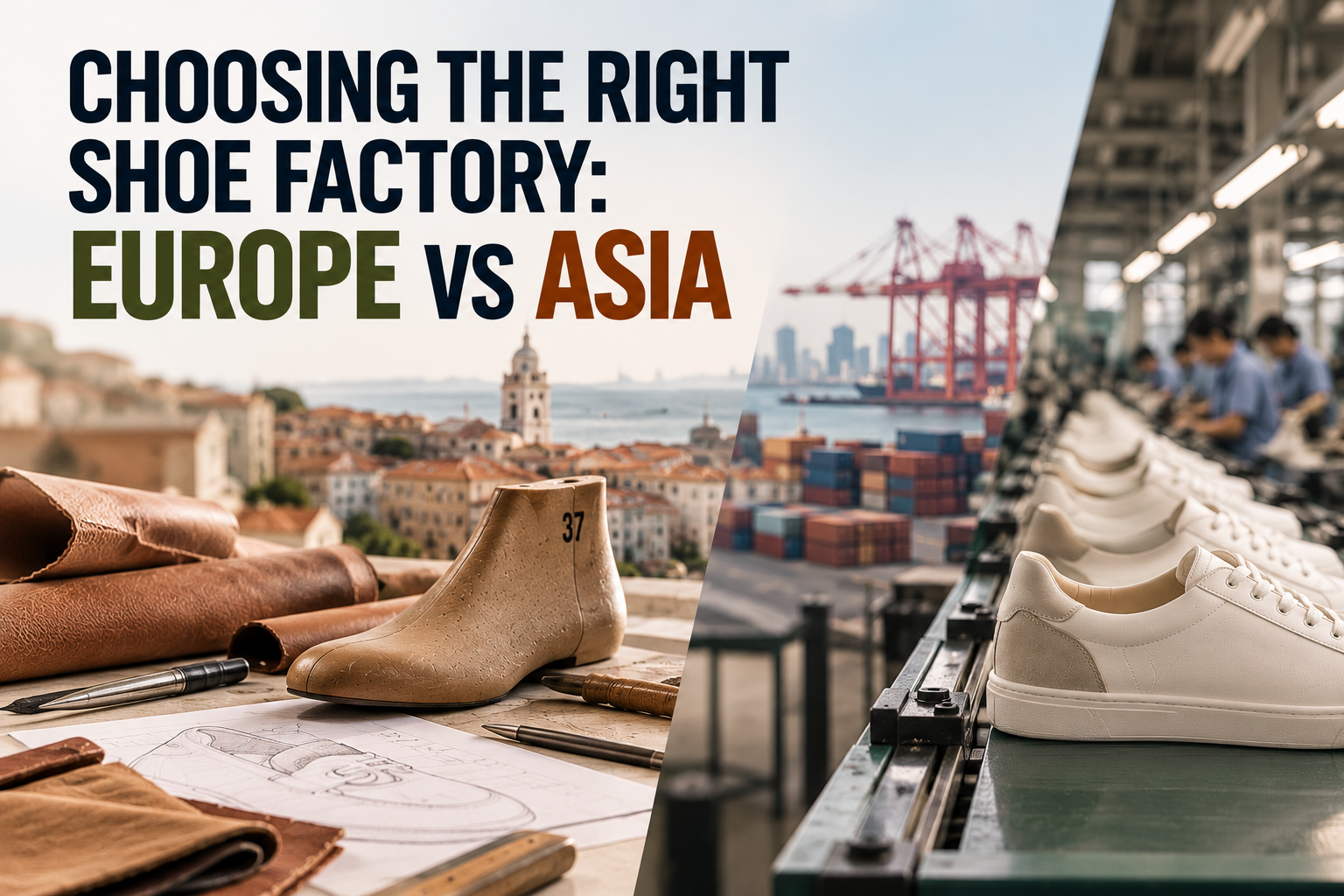
Choosing the right shoe factory is one of the most important decisions a footwear brand can make. The factory you select will influence not only production costs, but also product quality, development speed, minimum order quantities, communication and your ability to react to market changes.
For many brands, the first question is geographical: Europe or Asia?
Asia is often associated with lower manufacturing costs and large-scale production, while Europe is linked to proximity, craftsmanship and flexibility. But these assumptions only tell part of the story. In fact, the right choice depends on your product, volumes, target price, development needs and overall business model. Rather than asking which region is better, brands should ask a more useful question: Which shoe factory is the best fit for our strategy?
Europe vs Asia: What Should Footwear Brands Compare?
FOB price is usually the first number brands compare, but it should never be the only one. A lower unit price can be offset by higher minimum order quantities, longer transport times, larger inventory commitments or additional development rounds. Equally, choosing a factory purely because it is geographically close does not guarantee the right technical capabilities or cost structure.
A better comparison looks at the complete sourcing model. European manufacturing generally involves higher production costs, but can offer shorter lead times to European markets, smaller production volumes and close product development. Asian manufacturing is often more competitive for medium to very large volumes and benefits from extensive, highly integrated supply chains. However, flexibility, development support and quality depend heavily on the individual supplier in both regions.
These are broad patterns, not universal rules. An excellent Asian shoe manufacturer can outperform a poorly managed European supplier, and vice versa. Geography matters, but factory capability matters more.
Three factors deserve particular attention.
- Cost and production volumes. Asia can be highly competitive when volumes are large and products are engineered for scale. European production may be more attractive for brands that need smaller quantities, premium materials or frequent collection changes.
- Lead times, development and communication. For brands selling mainly in Europe, shorter transport distances can make replenishment easier and reduce exposure to long shipping cycles. Complex footwear also requires constant decisions around materials, constructions, fitting, components and finishing. The easier it is to communicate and solve problems during development, the lower the risk of expensive mistakes later.
Discover how to find reliable shoe factories in Europe here
When Does a European Shoe Factory Make More Sense?
A European shoe factory can be a strong option when the business model depends on flexibility, close product development and relatively short supply chains. This is often the case for premium and contemporary brands producing small to medium volumes. Brands launching several collections per year may also benefit from easier communication and the ability to visit factories more frequently.
Europe has specialised footwear clusters with deep technical expertise, particularly in countries such as Portugal, Italy and Spain. These ecosystems bring together factories, component suppliers, tanneries, technicians and skilled labour.
European production may make particular sense when:
- Product development requires frequent interaction;
- Order volumes are not large enough for highly industrialised production;
- Speed to European markets is important;
- Premium materials and specialized constructions are central to the product;
- The brand wants greater flexibility between collections.
However, Europe is not automatically the right answer. Costs can be higher, capacity may be limited in peak periods and not every footwear factory has the machinery or expertise required for every product category.
When Does an Asian Shoe Factory Make More Sense?
Asia remains one of the world’s most important footwear manufacturing regions for good reason. Countries such as China, Vietnam, India and Indonesia have developed extensive production ecosystems capable of supporting everything from components and tooling to highly automated assembly lines.
An Asian shoe factory can be particularly competitive when production volumes are large, target prices are highly cost-sensitive, products require industrial scale, the supply chain is already established in the region, or specialised machinery, moulds and components are locally available.
For sneakers, technical footwear and other highly industrialised products, some Asian manufacturing clusters offer capabilities that can be difficult to replicate elsewhere at the same scale.
The main challenge is not that Asia is “far away” or inherently less flexible. The real issue is selecting the right supplier and building the right operational structure around that relationship. Lead times, communication, quality control and logistics all need to be managed according to the brand’s business model.
Could a Hybrid Sourcing Strategy Be the Best Option?
For some brands, the best answer is neither Europe nor Asia alone. A hybrid sourcing strategy can allocate different products to different regions according to their technical and commercial requirements. A brand might develop premium leather styles in Europe while producing higher-volume or more industrialised categories in Asia.
This approach can reduce dependence on a single region while matching each product with the most suitable manufacturing ecosystem.
The key is to avoid splitting production without a clear rationale. A hybrid strategy only works when product allocation, quality standards and supplier management remain consistent.
Explore 10 sourcing mistakes fashion and footwear brands should avoid here
Final Thoughts
Choosing the right shoe factory is not simply a choice between Europe and Asia. It is a decision about how your brand wants to develop products, manage inventory, control quality and scale over time.
Europe can offer proximity, flexibility and strong specialised manufacturing clusters. Asia can provide exceptional scale, competitive cost structures and deeply integrated supply chains. Both regions have excellent factories, and both have suppliers that may be unsuitable for a particular brand.
The strongest sourcing strategies begin with the product and business model — not with assumptions about geography. A factory should ultimately be selected because its capabilities, structure and way of working support where the brand wants to go.