Minimum order quantities are one of the first challenges many footwear brands face when approaching a shoe factory. A brand may want to test a new style with 100 pairs, while the manufacturer requests 500. Another factory may accept a lower total quantity but require minimums per color. Even when the shoe factory is flexible, material and component suppliers may impose their own conditions.
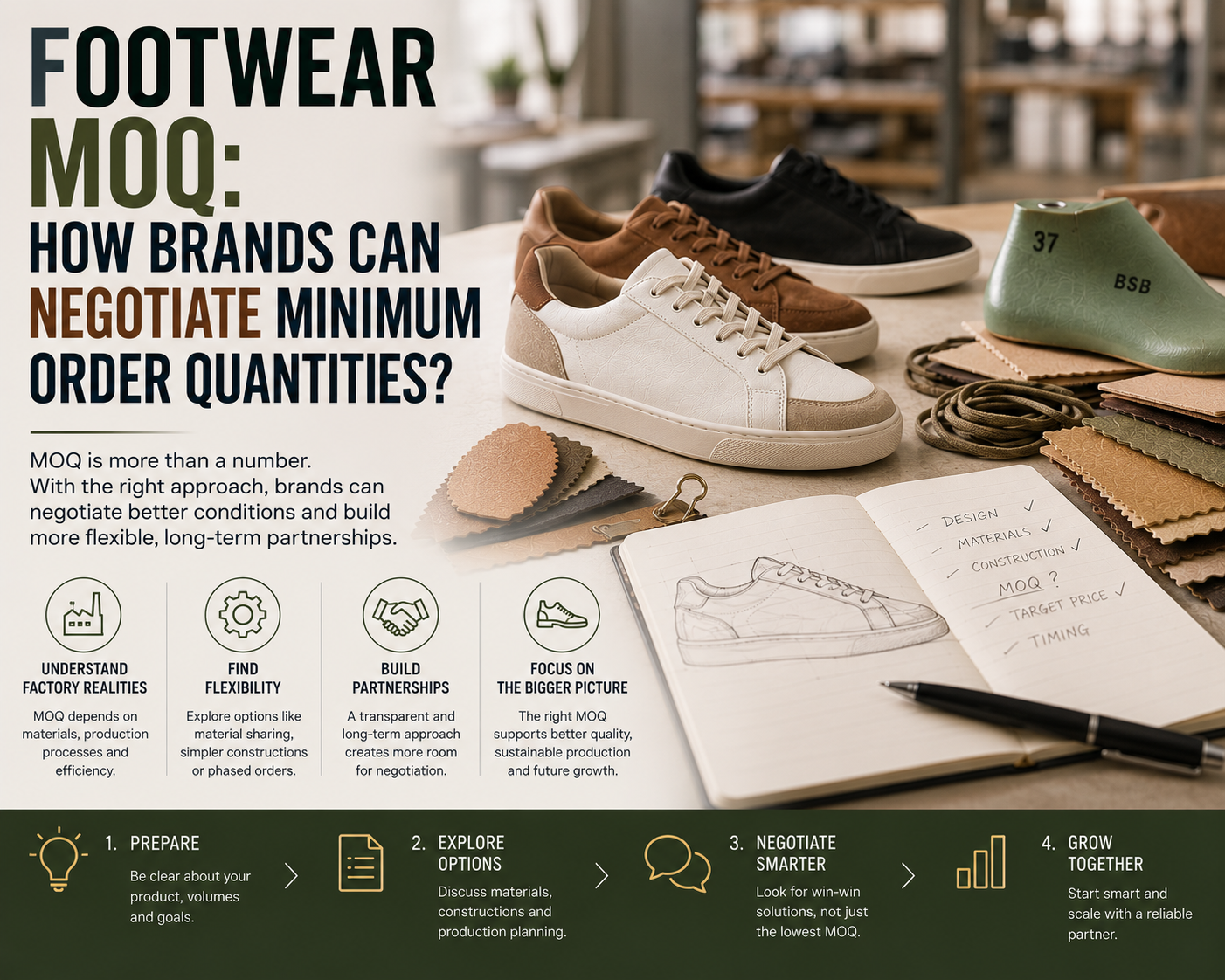
This can make footwear MOQs seem arbitrary. Usually, they are not. Minimum order quantities are influenced by how shoes are developed, how materials are purchased and how efficiently production can be organized. Understanding these factors gives brands a much stronger basis for negotiation.
The objective should not simply be to push a factory towards the lowest possible number. It should be to find a production structure that works for both sides.
What Determines a Footwear MOQ?
There is no universal minimum order quantity for shoes. In fact, footwear MOQ requirements vary according to the factory, product category, construction, materials, components and production setup. A highly industrialized sneaker factory may work with very different volumes from a smaller manufacturer specializing in premium leather footwear.
Several factors can influence the minimum, including factory size and production model, product complexity, minimum material purchases, outsole and component availability, number of colors, size range, setup time between production runs and level of customization.
This is why asking “What is your MOQ?” without discussing the product often leads to an incomplete answer. A better question is: What is driving the MOQ for this specific project? Once that is clear, negotiation becomes more practical.
Factory MOQ and Material MOQ Are Not the Same Thing
One of the most important distinctions in footwear sourcing is the difference between a production MOQ and a supplier MOQ. A shoe factory may be willing to manufacture 150 pairs of a style. But the leather supplier may require a larger minimum quantity for a custom color. An outsole supplier may impose a minimum production run. A branded buckle, woven label or packaging component may create another constraint.
In practice, the final footwear MOQ can be determined by the least flexible element in the supply chain. This is particularly relevant for customized products. A brand requesting exclusive colors, new tooling and unique components should not expect the same minimums as a brand using materials and constructions already available within the factory’s supply network. Before negotiating quantities, identify where the real constraint sits.
Why MOQs Per Color Matter?
Brands often focus on the total order quantity while factories focus on how that quantity is divided. An order of 600 pairs may sound attractive. But if it is split across six colors, the factory is effectively managing six production runs of 100 pairs.
Each color can involve separate material purchasing, cutting preparation, production organization and quality control. Frequent changes reduce efficiency and increase the risk of leftover materials. For this reason, a factory may accept 300 pairs in one color but reject 300 pairs across five colors. In reality, the total volume is identical but the production reality is not.
One of the most effective ways to negotiate a footwear MOQ is therefore to reduce fragmentation. Fewer colors with stronger quantities are often easier to accommodate than a broad collection with very small runs.
Discover what are private label products here
How Can Brands Negotiate Lower MOQs?
Good MOQ negotiation starts with understanding the factory’s constraints rather than simply asking for an exception. Several approaches can create flexibility:
- Use Existing Materials and Components: If a brand selects leather colors, outsoles or components already used by the shoe factory, supplier minimums may be easier to manage.
- Reduce the Number of Colors: Concentrating volume into fewer colorways can make a small order more efficient and commercially attractive.
- Share Materials Across Styles: Different styles may use the same leather, lining, outsole family or components. This can increase purchasing volume without requiring a high quantity for every individual style.
- Accept a Higher Unit Price: Small production runs are often less efficient. In some cases, a shoe manufacturer may accept a lower MOQ if the unit price reflects additional setup time, material waste or production complexity. A slightly higher FOB price can still be preferable to purchasing inventory the brand does not need.
What Should Brands Avoid During MOQ Negotiations?
Some approaches can damage the conversation before production even begins. Brands should avoid treating every minimum as evidence that a factory is unwilling to cooperate. A manufacturer may genuinely face constraints outside its direct control.
It is also risky to push quantities so low that the factory loses interest in the order. A supplier that reluctantly accepts an uneconomic project may not prioritize it when production becomes busy.
Another common mistake is negotiating the MOQ before the product is clearly defined. Changing materials, colors or components later may completely alter the conditions originally discussed. The strongest negotiations are based on transparent information from both sides.
Finding the Right Footwear MOQ
Footwear MOQs should not be treated as fixed numbers without context. They are often the result of several interconnected factors: material purchasing, color fragmentation, production efficiency, components and factory setup. Brands that understand these constraints are usually in a stronger position to negotiate.
Sometimes the solution is a lower quantity. Sometimes it is fewer colors, shared materials, a higher unit price or a different product structure. The best MOQ negotiation is not about forcing a shoe factory to accept an unrealistic order. It is about finding the point where commercial ambition and manufacturing reality can work together.