
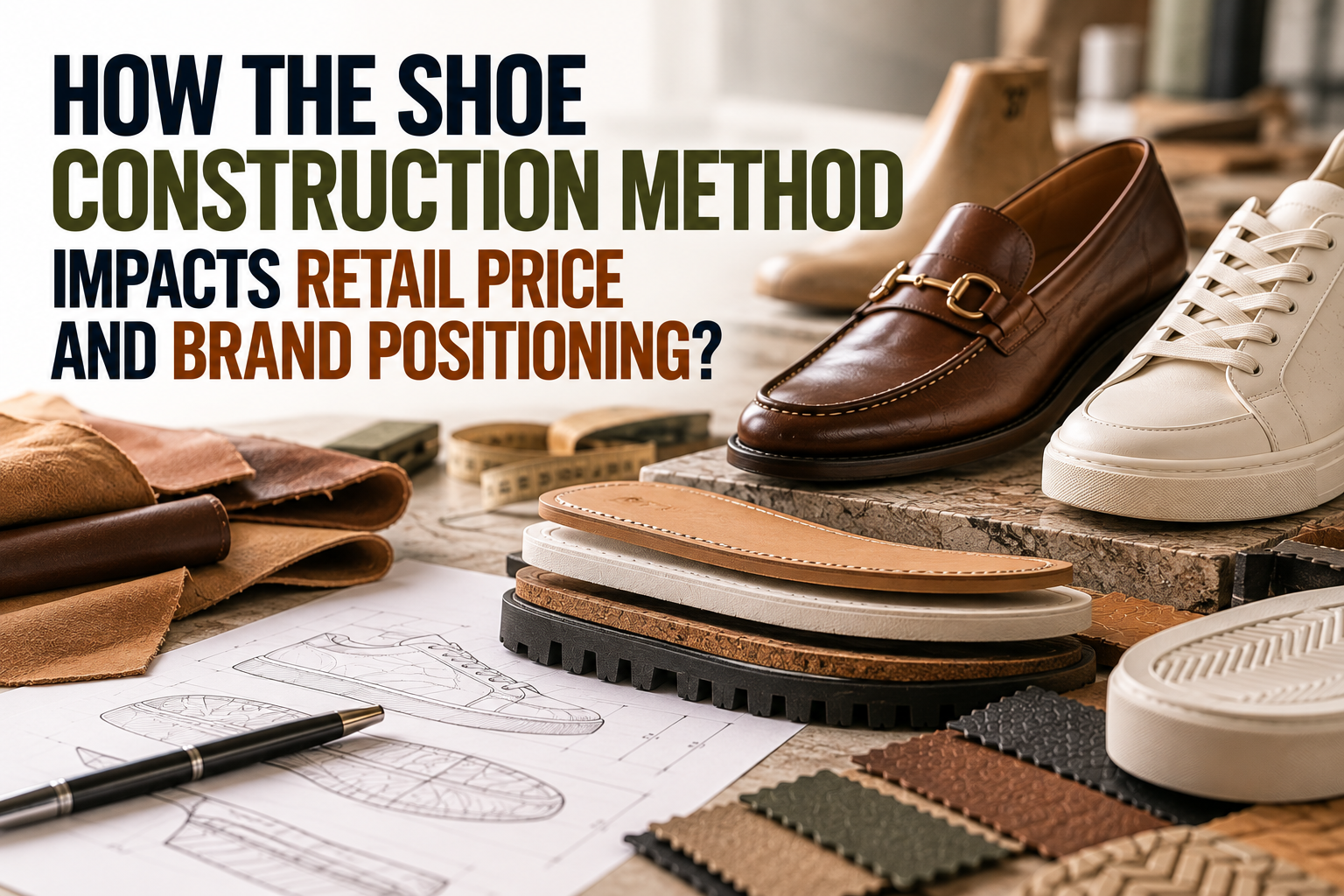
Choosing a shoe construction is often treated as a technical decision. How will the upper be attached to the sole? Which machinery is required? What materials are compatible with the process? These questions matter. But construction also influences manufacturing cost, product appearance, comfort, repairability and the story a brand can credibly tell about its footwear.
A lightweight sneaker built with Strobel construction occupies a very different product space from a Goodyear welted leather boot. A refined cemented pump communicates something different from a Blake-stitched loafer.
None of these methods is automatically better. The important question is whether the construction supports the product, target retail price and intended brand positioning.
How Do Shoe Construction Methods Affect More Than Manufacturing Cost?
Different shoe construction methods require different combinations of labor, machinery, materials and production time. Some are designed for industrial efficiency, while others involve specialized operations or skilled manual work. Certain constructions require additional components, while others are engineered to reduce weight and increase flexibility.
These differences influence factory cost, but the relationship between construction and retail price is not linear. A shoe that costs more to manufacture does not automatically justify a higher retail price. The customer must also recognize value through design, materials, comfort, craftsmanship, performance or brand perception.
This is why construction should be considered early in footwear development rather than selected only after the design is complete.
Explore 6 Essential Shoe Constructions Methods here
What Is Cemented Construction Best Suited For?
Cemented construction is one of the most widely used methods in footwear manufacturing. The upper is lasted and attached to the sole using adhesive systems. The method supports a broad range of products, including pumps, sandals, loafers, boots and casual shoes.
Cemented construction can be used for accessible products or high-end footwear made with premium leathers, sophisticated components and extensive hand finishing.
For many fashion and contemporary brands, cemented construction offers a useful balance between design freedom, cost and production scalability.
How Does Blake Construction Support Premium Positioning?
In Blake construction, stitching passes through the outsole, upper and insole, creating a direct connection between the main parts of the shoe. The method is often associated with refined leather footwear and can support relatively slim, flexible silhouettes.
From a positioning perspective, Blake construction offers something valuable: a technical feature that can become part of the product story.
For brands operating in premium leather footwear, this may help communicate craftsmanship and construction knowledge. However, the construction alone does not create premium value. The last, leather, finishing, stitching quality and overall product execution still determine whether the final shoe supports the intended retail price.
A Blake-stitched shoe made with average materials does not automatically become a luxury product.
What Makes Goodyear Welted Construction Different?
Goodyear welted construction is strongly associated with traditional shoemaking, durability and repairability. The process uses a welt to connect the upper and insole assembly to the outsole. It involves specialized machinery, additional components and a more complex manufacturing sequence than many mainstream construction methods.
For brands selling classic shoes or boots, Goodyear welted construction may reinforce positioning around longevity, craftsmanship, heritage and repairability.
However, there is a strategic trade-off. If the target consumer prioritizes extreme lightness, softness or a highly contemporary fashion silhouette, a traditional welted construction may not be the most appropriate choice simply because it is perceived as prestigious.
Why Is Strobel Construction Used in Sneakers?
Strobel construction is widely used in sneakers, athletic footwear and other products where flexibility and lightweight performance are important. The upper is stitched to a fabric bottom, creating a sock-like structure before the sole assembly is completed. This method supports a very different positioning from traditional leather shoe constructions.
Its value may come from flexibility, comfort, reduced weight and athletic performance. For sports and lifestyle brands, these characteristics can justify significant retail prices even when consumers do not associate the product with traditional craftsmanship.
This highlights a broader principle: premium positioning does not always mean more traditional construction.
A technically advanced sneaker can command a higher retail price than a conventionally made leather shoe if its performance, design and brand proposition support that value.
How Does Shoe Construction Affect Retail Price?
Construction is only one part of retail price architecture. Brands must also consider materials, components, tooling, labor, development costs, logistics, wholesale and retail margins, marketing and distribution.
Choosing a more expensive construction without understanding the complete commercial model can create problems later. If manufacturing cost increases significantly but the target customer does not perceive additional value, margins may come under pressure.
Equally, selecting the cheapest possible construction can weaken a product if it conflicts with the brand’s positioning. The objective is not to maximize or minimize construction cost. It is to invest where the customer proposition benefits.
How Should Brands Choose the Right Shoe Construction?
Shoe construction sits at the intersection of engineering, cost and brand strategy. It influences how a product is manufactured, how it feels, how it performs and what stories can credibly be communicated around it.
Cemented, Blake, Goodyear welted and Strobel constructions serve different purposes. None should be selected simply because it is cheaper, more traditional or perceived as more premium.
The right construction is the one that supports the product because, ultimately, customers do not buy a manufacturing process. They buy what that process allows the shoe — and the brand — to deliver.