
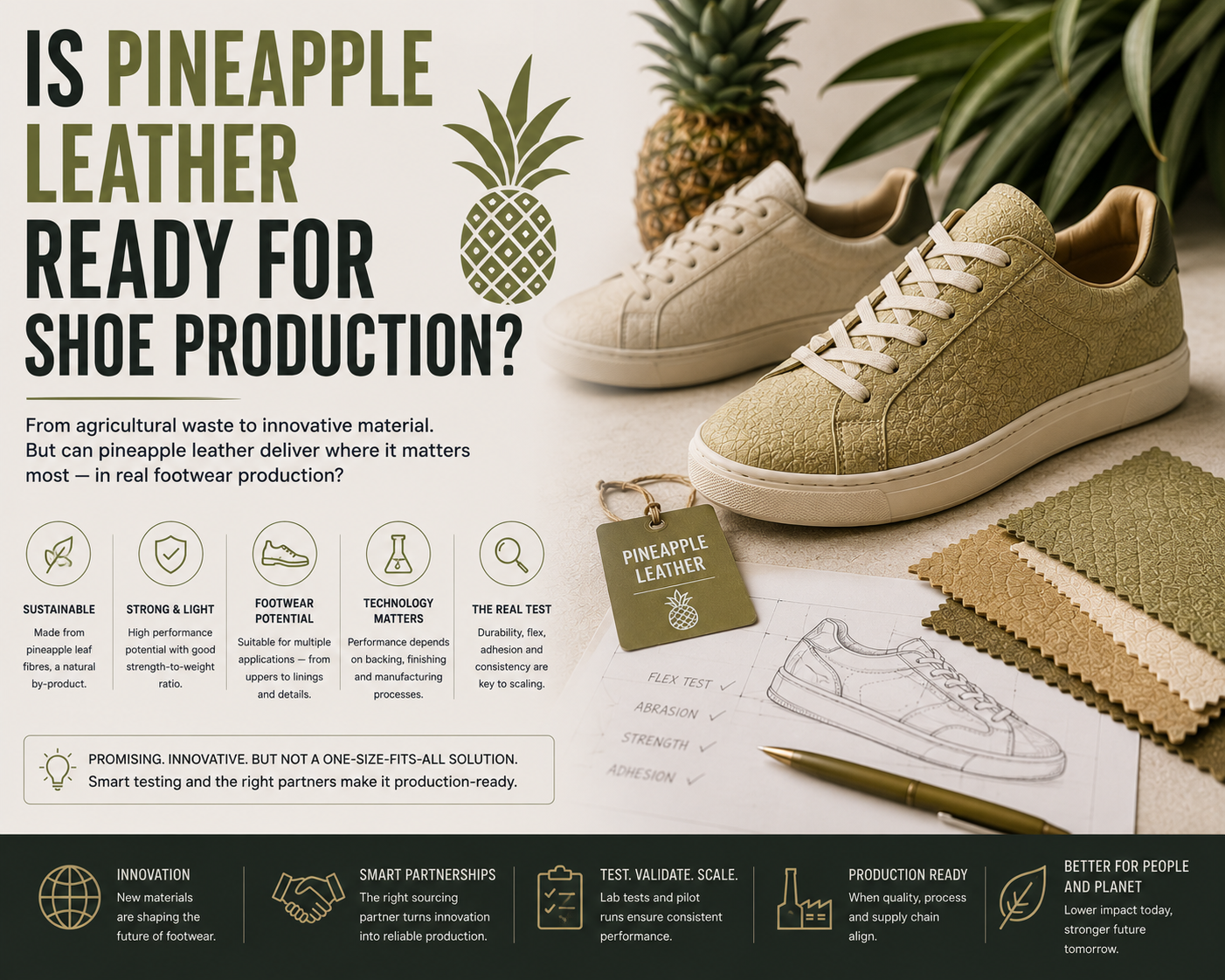
Pineapple leather, better known as Piñatex, has already gained attention in the fashion industry. But can this innovative material go beyond accessories and enter the demanding world of footwear production?
The short answer is yes, with some limitations and plenty of opportunities. For brands exploring sustainable footwear materials, Piñatex offers an interesting combination of agricultural waste recovery, distinctive aesthetics, and potential applications in footwear development.
Why Are Footwear Brands Interested in Pineapple Leather?
Sustainability and traceability have become increasingly important in modern footwear sourcing. Brands are looking for vegan and renewable materials that can meet the functional requirements of footwear while supporting more responsible product strategies.
Piñatex stands out because it is made using pineapple leaf fibers, an agricultural byproduct that would otherwise have limited value. Its textile-like appearance also gives designers a distinctive alternative to conventional leather and synthetic materials.
For footwear brands, its main appeal comes from the combination of material innovation and storytelling. Piñatex can support collections that want to communicate sustainability without completely changing the visual language of the product.
What Are the Main Benefits of Pineapple Leather for Footwear?
Pineapple leather offers several characteristics that make it relevant for footwear development. It uses agricultural waste rather than requiring dedicated crops, while its distinctive surface provides designers with an alternative aesthetic to traditional leather.
The material is also vegan and cruelty-free, making it relevant for brands developing animal-free footwear collections. Its natural, textile-like texture can add visual differentiation to sneakers, sandals, casual shoes, and fashion-oriented products.
From a sourcing perspective, however, brands should assess the specific Piñatex formulation and finish rather than treating all pineapple-based materials as identical. Thickness, coating, flexibility, and construction compatibility can vary depending on the intended application.
Where Pineapple Leather Can Be Used in Footwear Production?
Piñatex has demonstrated potential in lifestyle sneakers, sandals, casual shoes, and fashion footwear, particularly where aesthetics, flexibility, and material storytelling are important.
It can be considered for upper components, linings, decorative panels, and selected low-wear areas. Its appearance makes it particularly interesting for capsule collections, prototypes, and limited editions where material innovation forms part of the product proposition.
For brands developing pineapple leather footwear, starting with specific components or lower-risk applications can be a practical way to evaluate the material before considering broader use across a collection.
What Are the Challenges of Using Pineapple Leather in Shoes?
Piñatex is still an evolving material, and it should not automatically be considered a one-to-one replacement for animal leather across every footwear application.
Durability can be a consideration in high-friction areas, meaning reinforcement or hybrid material constructions may be required. Water resistance can also depend on the coating and finishing system, particularly when footwear is intended for outdoor or demanding environments.
Natural fiber characteristics can create variations in texture and thickness, while factory familiarity is another important consideration. Not every footwear manufacturer has experience with bio-based materials, so the cutting, stitching, bonding, and finishing processes may require additional development and testing.
These technical factors make early collaboration between the material supplier, footwear factory, and brand particularly important.
How Can Brands Scale Pineapple Leather From Prototype to Production?
Brands that successfully introduce pineapple leather into footwear often approach development progressively. Instead of immediately committing to large-scale production, they can begin with prototypes, small production runs, or capsule collections.
This approach allows teams to evaluate how the material behaves during cutting, stitching, lasting, bonding, and finishing. It also gives the brand an opportunity to assess durability and customer response before expanding the material into additional products.
A structured development process can therefore help transform Piñatex footwear from an interesting sustainability concept into a commercially viable product.
What Should Brands Consider Before Sourcing Pineapple Leather?
Before selecting Piñatex for a footwear collection, brands should evaluate the material against the requirements of the specific product.
The key considerations include the intended footwear category, expected wear level, material thickness, flexibility, abrasion resistance, water resistance, finishing, construction method, target price, minimum order quantities, and factory capabilities.
The sustainability story should also be supported by reliable documentation and transparent sourcing information. This is particularly important as consumers and regulators increasingly expect brands to substantiate environmental claims.
Is Pineapple Leather Ready for Footwear?
Pineapple leather is ready for selected footwear applications, but it is not a universal replacement for traditional leather. Its strongest opportunities currently lie in lifestyle, fashion, vegan, and sustainability-focused products where aesthetics and material storytelling are important.
For forward-thinking footwear brands, pineapple leather footwear represents both an opportunity and a development challenge. Piñatex can help brands explore more circular material strategies while creating products with a distinctive story.
The most effective approach is to use the material strategically, test it under real manufacturing conditions, and work closely with experienced material suppliers and footwear factories.
Pineapple leather will not replace traditional leather overnight, but it is already contributing to the evolution of more responsible and circular footwear production. For brands willing to experiment, Piñatex represents a combination of innovation, sustainability, and design potential that can be developed into commercially relevant footwear.