
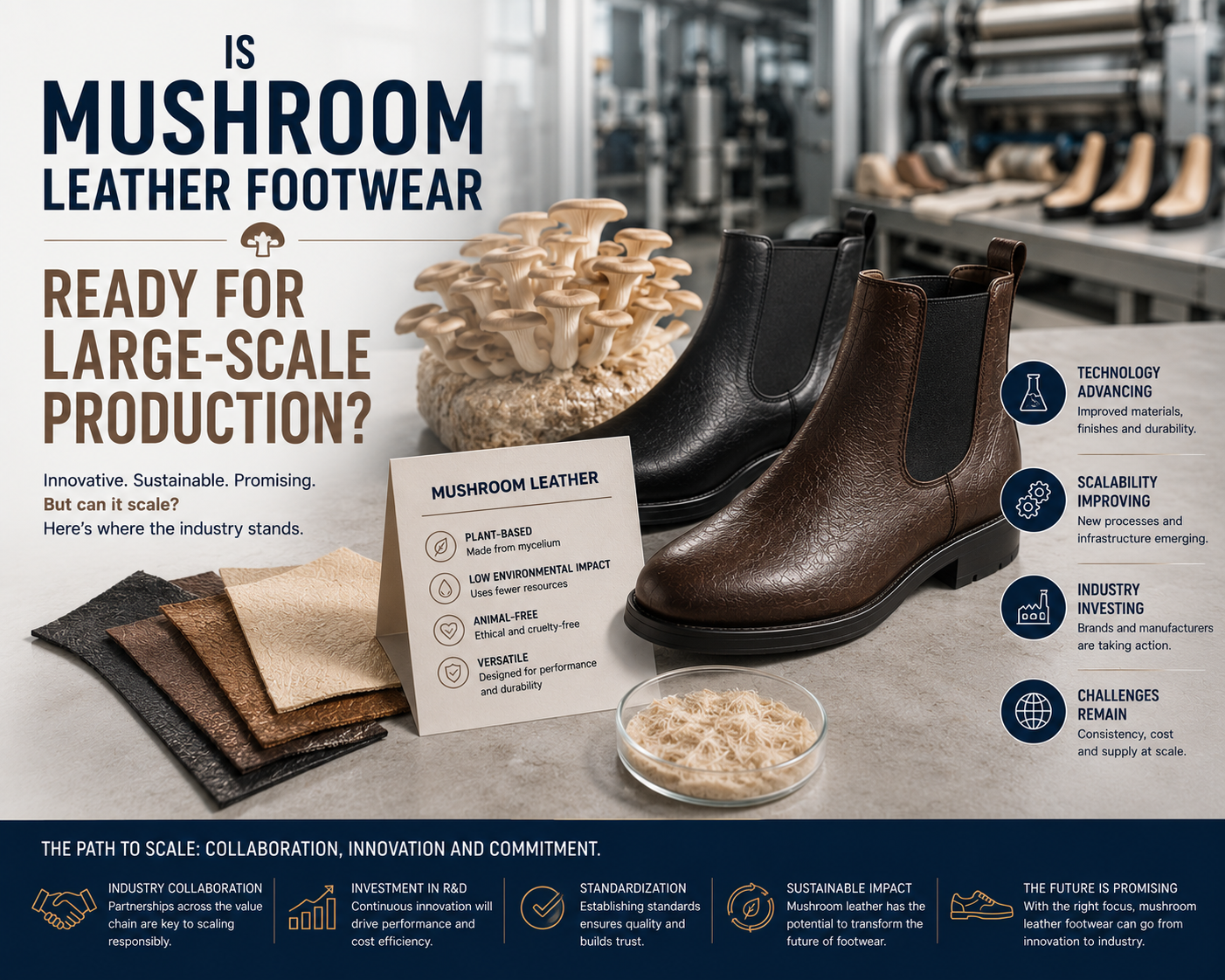
Mushroom leather footwear is emerging as one of the most promising sustainable alternatives to traditional leather. While mycelium-based materials offer strong environmental benefits, lightweight performance, and innovative design possibilities, challenges around scalability, durability, and cost still limit widespread adoption. However, ongoing research and industrial investment are rapidly bringing mushroom leather closer to mainstream footwear production.
Why Is Mushroom Leather Footwear Gaining Attention?
As sustainability becomes a strategic priority for footwear brands, mushroom leather shoes has emerged as a compelling alternative to animal and synthetic materials. Derived from mycelium – the root structure of fungi – this innovative material combines environmental responsibility with modern design potential.
For brands looking to future-proof their collections, mushroom leather offers a unique opportunity to align sustainability goals with consumer demand for responsible products.
What Makes Mushroom Leather Suitable for Footwear?
Several characteristics make mycelium-based materials attractive for shoe manufacturing:
- Lightweight and flexible, adapting to different footwear constructions.
- Soft-touch surface that delivers comfort similar to premium leather.
- Lower environmental impact compared to conventional leather production.
- Reduced water and chemical consumption during manufacturing.
- Biodegradable and animal-free, supporting circular economy initiatives.
These qualities make mushroom leather footwear particularly relevant for brands developing sustainable sneakers, casual shoes, and fashion-forward collections.
How Does Mushroom Leather Compare to Traditional Materials?
| Factor | Mushroom Leather | Animal Leather | Synthetic Leather |
| Sustainability | High | Moderate | Low |
| Water Consumption | Low | High | Moderate |
| Animal-Free | Yes | No | Yes |
| Biodegradability | Partial to High | Partial | Low |
| Design Flexibility | High | High | High |
| Industrial Scalability | Developing | Mature | Mature |
While traditional materials still offer greater production capacity, mushroom leather is rapidly improving in both performance and availability.
What Challenges Limit Large-Scale Mushroom Leather Footwear Production?
Despite significant progress, several barriers remain before mushroom leather can be adopted at scale.
Durability and Performance Consistency
Material performance can vary between suppliers. Factors such as abrasion resistance, elasticity, and tear strength are still being optimized to meet the demanding requirements of footwear manufacturing.
Industrial Scalability
Current production volumes remain relatively limited. Large international footwear brands require substantial material quantities that few mushroom leather suppliers can consistently provide today.
Cost Competitiveness
Compared to conventional leather and synthetic alternatives, mushroom leather remains more expensive due to limited production capacity and ongoing research investments.
Supply Chain Readiness
Many footwear factories are still adapting their processes to work efficiently with bio-based materials. Wider adoption will depend on greater integration across the footwear supply chain.
Who Is Driving Innovation in Mushroom Leather?
Several industry leaders are accelerating the development of mushroom leather technologies.
Notable innovators include:
- MycoWorks
- Bolt Threads
Research organizations are also playing an important role in validating material performance for industrial applications, including INESCOP and CTCP.
These collaborations help bridge the gap between laboratory innovation and commercial footwear manufacturing.
What Opportunities Does Mushroom Leather Create for Footwear Brands?
Forward-thinking brands can already benefit from exploring mushroom leather applications.
Key advantages include:
- Product differentiation through sustainable innovation.
- Strong storytelling for environmentally conscious consumers.
- Reduced environmental footprint across the product lifecycle.
- Early access to next-generation sustainable footwear materials.
- Enhanced brand credibility within the growing circular fashion movement.
Many brands are currently integrating mushroom leather into limited editions, capsule collections, and prototype development programs to test market demand.
Is Now the Right Time to Explore Mushroom Leather Footwear?
Although mushroom leather footwear is not yet fully ready for mass-market production, the technology is advancing rapidly. Improvements in manufacturing capacity, material performance, and supply-chain integration are making mycelium leather increasingly viable for commercial footwear applications.
For brands working with experienced sourcing partners, now is an ideal time to evaluate mushroom leather through sampling, prototyping, and pilot collections. Early adoption can provide valuable insights while positioning brands at the forefront of sustainable footwear innovation.