
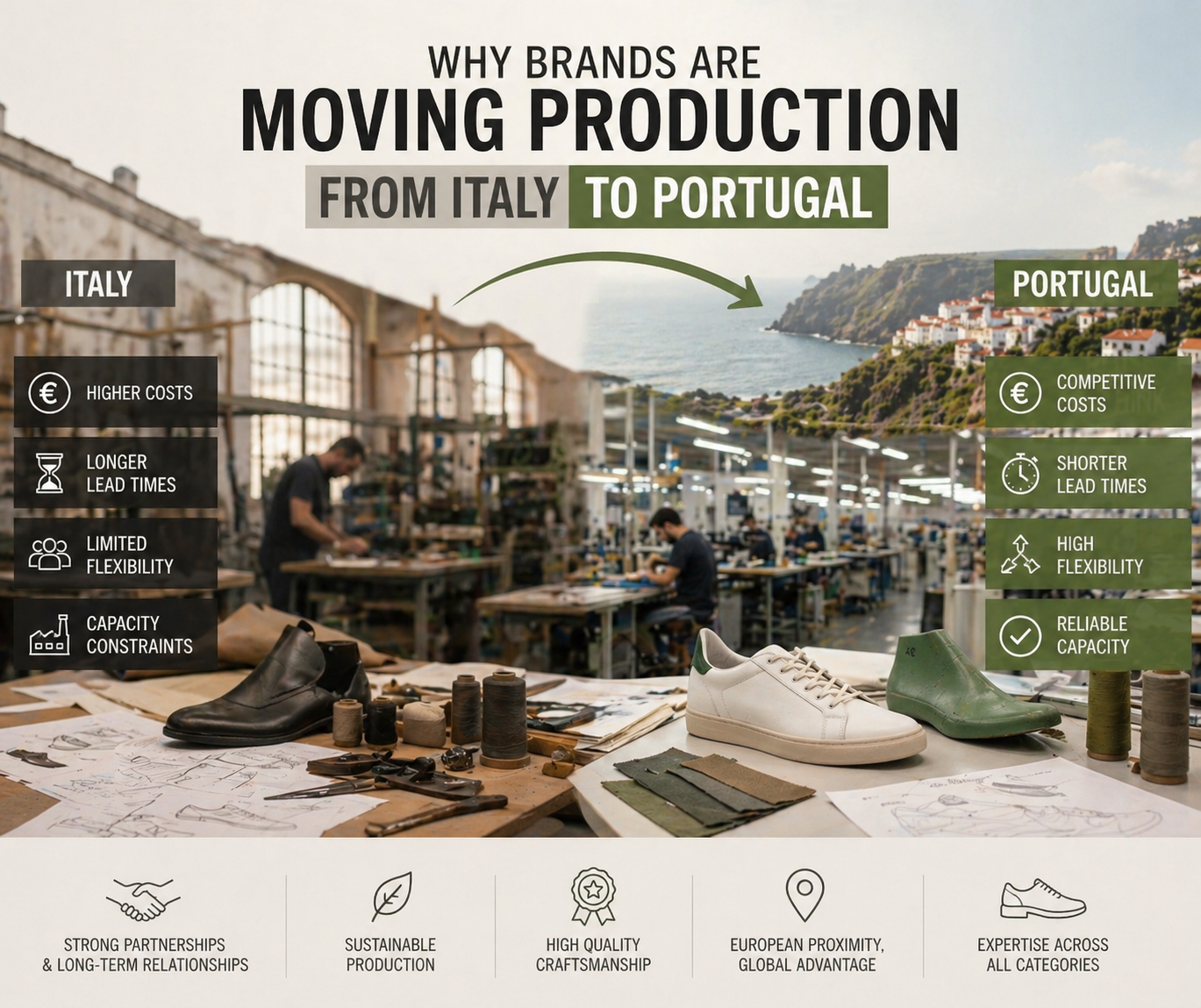
For decades, Italy dominated premium footwear production. However, rising costs and slower production cycles have pushed brands to explore alternatives. Portugal has emerged as a leading European sourcing hub, balancing craftsmanship with efficiency.
A New European Balance in Footwear Manufacturing
In recent years, a quiet shift has been transforming the European footwear landscape. More and more brands — from independent labels to established houses — are moving production from Italy to Portugal. What began as a pragmatic cost-saving decision has evolved into a strategic move grounded in flexibility, quality, and sustainability.
For decades, Italy was the undisputed reference in premium footwear manufacturing. But as global markets evolved and production costs rose, brands began to look for alternatives that could combine European craftsmanship with modern efficiency. Portugal emerged as that ideal balance — offering competitive pricing, high-quality execution, and a cooperative industrial culture.
Know more about the Portuguese footwear industry here
Cost Efficiency Without Compromise
Italian production remains exceptional, but its costs — labor, logistics, and raw materials — have increased steadily. Portugal provides a more cost-efficient environment, often reducing total production costs by 15–30% while maintaining comparable quality standards. This efficiency comes not from cutting corners but from streamlined processes, shorter supply chains, and highly adaptable factories that can scale production faster.
Discover why Portugal is one of the best destinations for footwear production here
Craftsmanship and Industrial Precision
Portugal’s success lies in its ability to merge traditional craftsmanship with modern technology. The country’s footwear sector is home to thousands of specialized artisans — pattern makers, stitchers, and technicians — working in facilities equipped with digital cutting, automated sewing, and direct injection systems.
- Skill-to-Speed Optimization: Digital systems allow for rapid prototyping and pattern adjustments.
- Agile Experimentation: Capability to handle smaller runs and limited editions without the overhead of traditional hubs.
- Technical Versatility: Facilities specialize in everything from high-fashion heels to technical performance sneakers.
Operational Flexibility and Collaboration
Unlike the highly segmented and rigid structure often found in Italian regions, Portuguese factories tend to be agile and collaborative. Brands can work directly with factory teams, adjust materials or components mid-development, and prototype new models in days rather than weeks or months. This flexibility makes Portugal particularly attractive for emerging brands or established labels diversifying their supply base.
Discover how to work with a shoe factory here
Sustainability as a Standard Framework
Sustainability is another factor accelerating this shift. Many Portuguese factories hold ISO Certifications with integrated systems for waste management, water recycling, and renewable energy. Furthermore, the industry’s proactive stance on eco-materials — including metal-free leathers and bio-based soles — reinforces its appeal to sustainability-conscious labels.
- Logistics Footprint: Shorter routes within the EU significantly reduce the carbon footprint of the final product.
- Material Traceability: European-sourced components ensure transparency and compliance with upcoming ESG regulations.
Strategic Nearshoring and Speed to Market
In an era of unpredictable global logistics, nearshoring has become a strategic advantage. Portugal’s geographic location provides fast delivery across Europe, with typical lead times of 6–8 weeks, compared to 12–16 weeks from Asia. This responsiveness allows brands to test, adapt, and restock collections quickly — a key competitive edge in today’s rapid fashion cycles.
Quality and Global Brand Perception
Producing in Portugal no longer means compromising on brand image. In fact, “Made in Portugal” has become synonymous with responsible European craftsmanship. Major brands in France, Scandinavia, and the UK increasingly highlight Portuguese manufacturing as part of their storytelling — a mark of ethical, high-quality, and transparent production.
The Future of European Excellence
The migration of footwear production from Italy to Portugal represents more than a cost-driven trend — it’s a redefinition of how and where European craftsmanship operates. Portugal’s unique mix of artisanal skill, industrial know-how, sustainability, and adaptability positions it as a long-term hub for premium and luxury footwear manufacturing. In this new European balance, Portugal is becoming the new center of excellence for brands that value creativity, responsibility, and precision.
Discover how working with a footwear sourcing agency may help your brand here