
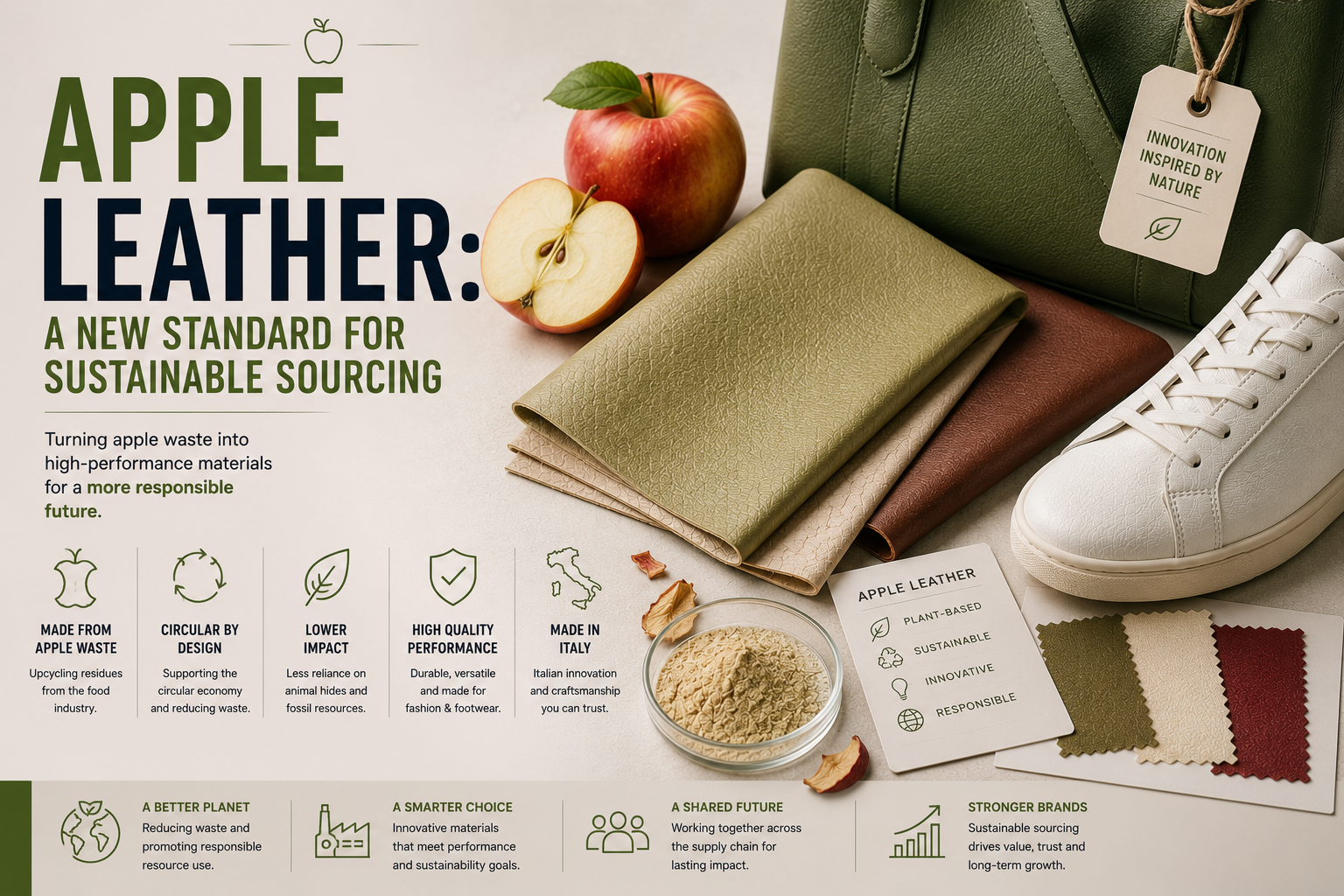
The development of Apple Leather, also known as AppleSkin™, marks a defining moment in sustainable material innovation. What began as a research project in Northern Italy has evolved into a global example of how agricultural waste can be transformed into high-value materials for fashion and footwear.
Why Is Apple Leather Changing Sustainable Sourcing?
For decades, sourcing decisions in fashion and footwear focused primarily on cost, production speed, and manufacturing capacity. Today, brands increasingly evaluate supply chains based on transparency, traceability, ethical practices, and environmental impact.
Apple Leather reflects this shift by transforming waste from the apple processing industry into a premium material that reduces dependence on animal hides while supporting regional manufacturing in Europe. Rather than creating new raw materials, it gives existing resources a second life, making sustainability part of the sourcing strategy rather than an afterthought.
How Does Apple Leather Support the Circular Economy Fashion?
One of the strongest advantages of Apple Leather is its practical application of circular economy principles. Instead of allowing apple waste from the food industry to become landfill, the material converts these byproducts into functional textiles suitable for fashion and footwear applications.
The manufacturing process follows a resource-efficient model. Apple residues from juice and food production are dried, processed into a fine powder, and combined with bio-based polymers to create a stable composite material. This approach reduces waste while replacing part of the petroleum content commonly found in traditional synthetic materials.
The result is a material that balances environmental responsibility with industrial performance, demonstrating how circular design can be successfully integrated into commercial manufacturing.
What Can Fashion and Footwear Brands Learn from Apple Leather?
The success of Apple Leather offers valuable lessons for brands seeking more responsible sourcing strategies.
First, sustainability and innovation are no longer separate objectives. Modern product development increasingly requires materials that deliver both technical performance and measurable environmental benefits.
Second, responsible sourcing depends as much on improving existing production systems as it does on developing entirely new materials. By rethinking how industrial waste is used, manufacturers can reduce environmental impact while creating commercially viable products.
Finally, collaboration remains essential. Material developers, researchers, manufacturers, and sourcing agencies all play a critical role in transforming innovative materials into scalable commercial solutions. Apple Leather illustrates how strong industrial ecosystems can accelerate sustainable innovation.
Why Is Smart Sourcing Becoming a Competitive Advantage?
As regulations evolve and consumers demand greater transparency, sourcing decisions increasingly influence both brand reputation and long-term competitiveness.
Smart sourcing means evaluating more than material appearance or cost. It requires brands to assess supply chain transparency, traceability, environmental performance, and end-of-life considerations alongside traditional manufacturing criteria.
For companies working with a fashion sourcing agency, materials such as Apple Leather demonstrate how responsible sourcing can strengthen product innovation while supporting broader sustainability objectives.
Is Apple Leather Setting a New Standard for Sustainable Materials?
AppleSkin™ shows that premium aesthetics and environmental responsibility can successfully coexist. By connecting agricultural recovery with advanced material science, Apple Leather provides a practical model for sustainable innovation that benefits manufacturers, brands, and consumers alike.
Rather than relying on resource-intensive production methods, it demonstrates how circular thinking can generate high-performance materials without compromising quality or design.
As fashion and footwear industries continue their transition toward more responsible production, Apple Leather represents an important step forward. It proves that the future of sustainable sourcing will be defined not by a single breakthrough, but by a growing portfolio of smarter material choices that combine innovation, traceability, and long-term environmental value.