
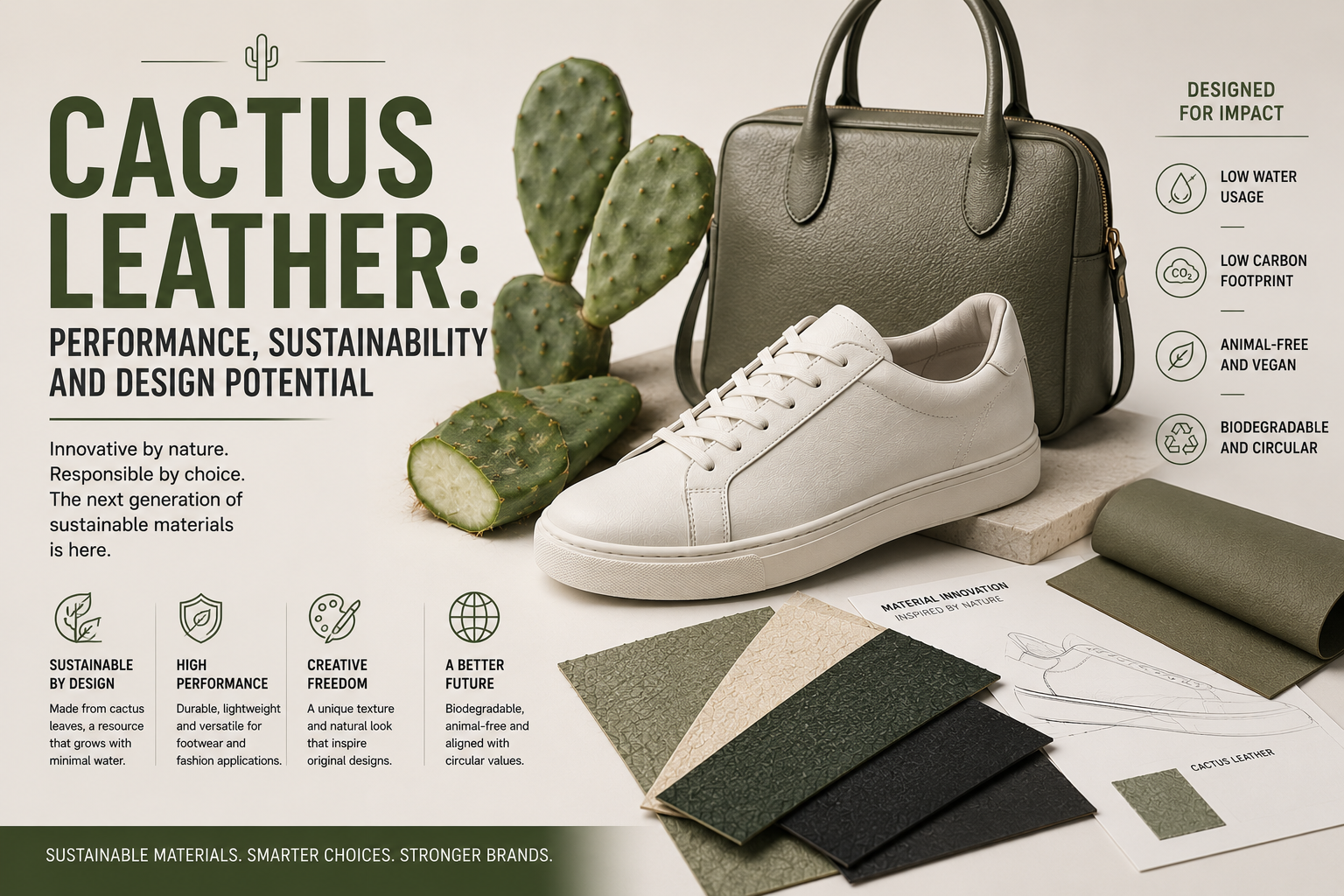
Cactus leather is a plant-based leather made from nopal cactus fibers and bio-based binders. Known for its low environmental impact, durability, flexibility, and aesthetic appeal, cactus leather has become one of the most promising sustainable leather alternatives for footwear, fashion accessories, and interior applications.
What Makes Cactus Leather Unique?
Cactus leather has captured the attention of designers, manufacturers, and sustainability experts alike. As demand for high-performance bio-based materials increases, this Mexican innovation demonstrates how nature and technology can work together to redefine modern leather alternatives.
Cactus leather (Desserto®) differs from traditional animal leather and synthetic materials throughout its entire lifecycle. Developed from the resilient nopal cactus, it offers a renewable and lower-impact solution for brands seeking sustainable materials.
The production process begins with harvesting mature cactus leaves without damaging the plant itself. The leaves are then transformed into organic biomass and blended with bio-based binders to create a flexible and durable material.
Its composition allows cactus leather to replicate many of the characteristics associated with genuine leather while significantly reducing environmental impact during production and end-of-life disposal.
How Does Cactus Leather Perform?
One of the main reasons brands are exploring cactus leather is its balance between performance and sustainability.
Despite being a relatively recent innovation, it offers strong technical characteristics suitable for fashion and footwear applications.
Key performance attributes include:
- Tensile strength suitable for handbags, accessories, linings, and casual footwear.
- Flexibility that adapts well to curved surfaces and stitched constructions.
- Good color retention, even when exposed to sunlight and UV radiation.
- Natural water resistance enhanced through eco-friendly coatings.
Although cactus leather is currently less elastic than premium animal leather, it delivers reliable durability and aesthetic stability for lifestyle and fashion-oriented products.
Why Is Cactus Leather Considered Sustainable?
Environmental performance is where cactus leather truly differentiates itself from conventional materials.
Compared with synthetic and animal-derived alternatives, its resource consumption and carbon footprint are substantially lower.
Some of its most important sustainability advantages include:
- Low water consumption since cactus plantations rely primarily on rainwater.
- Carbon sequestration during the plant’s natural growth cycle.
- A production process free from PVC, phthalates, and heavy metals.
- Regenerative harvesting methods that allow leaves to regrow every few months.
- Reduced dependence on resource-intensive livestock farming.
This combination of renewable sourcing and industrial adaptability positions cactus leather among the leading next-generation biomaterials.
Explore how to create sustainable shoes here
Environmental performance is where cactus leather truly differentiates itself from conventional materials.
Compared with synthetic and animal-derived alternatives, its resource consumption and carbon footprint are substantially lower.
Some of its most important sustainability advantages include:
- Low water consumption since cactus plantations rely primarily on rainwater.
- Carbon sequestration during the plant’s natural growth cycle.
- A production process free from PVC, phthalates, and heavy metals.
- Regenerative harvesting methods that allow leaves to regrow every few months.
- Reduced dependence on resource-intensive livestock farming.
This combination of renewable sourcing and industrial adaptability positions cactus leather among the leading next-generation biomaterials.
What Are the Design Benefits of Cactus Leather?
Beyond sustainability, cactus leather offers significant creative potential for designers and product developers.
The material can be manufactured in multiple grain patterns, thicknesses, and surface finishes, enabling brands to maintain aesthetic flexibility without compromising environmental objectives.
Cactus leather offers several design advantages that appeal to brands seeking both aesthetics and sustainability. Its soft touch creates a premium tactile experience, while its matte finish provides a natural and contemporary appearance. The material delivers consistent coloration, ensuring uniform product quality across production runs. It can also be manufactured with different textures and embossing effects, giving designers greater creative freedom. In addition, its dimensional stability supports precise cutting, stitching, and assembly processes, making it suitable for scalable footwear and accessories production.
These characteristics have made cactus leather increasingly attractive for:
- Sneakers
- Handbags
- Fashion accessories
- Upholstery applications
- Sustainable capsule collections
Which Industries Are Adopting Cactus Leather?
Since its commercial introduction, Desserto® cactus leather has gained traction across several industries.
Adoption has been particularly strong among brands seeking alternatives that combine technical performance with responsible sourcing practices.
Applications currently include:
- Fashion brands developing vegan leather collections.
- Footwear manufacturers launching sustainable product lines.
- Automotive companies exploring bio-based interior solutions.
- Luxury brands looking to integrate innovative materials into premium products.
This growing adoption reflects a broader industry movement toward materials that deliver both environmental responsibility and commercial viability.
Is Cactus Leather the Future of Sustainable Materials?
Cactus leather represents a new generation of biomaterials designed around regeneration rather than extraction.
Its combination of durability, visual appeal, renewable sourcing, and scalability demonstrates that sustainability no longer needs to come at the expense of performance or design.
As brands increasingly prioritize transparency, circularity, and responsible sourcing, cactus leather is likely to play an important role in the future of footwear, accessories, and fashion manufacturing.
Rather than asking designers and manufacturers to compromise, cactus leather proves that innovation, aesthetics, and sustainability can evolve together.